The business that keeps everything it earns
A regulated utility is the one kind of business where spending money is how you grow: the regulator allows a return on capital invested, so capital expenditure builds the earnings base instead of consuming it. BHE has run that machine for twenty-seven years without ever sending a dividend upstairs.
Berkshire Hathaway Energy has never paid a dividend to its parent. Everything it has earned since 1999 has stayed inside it, and been spent at roughly twice the rate of depreciation, which, for a regulated utility, is the whole mechanism of growth.
- 1 Assets have compounded at 10.6% a year for 26 years, from $10.8 B in 1999 to $148.3 B in 2025, a 13.8× increase. Equity compounded faster still, at 16.6%, because none of it was ever paid out.
- 2 Return on equity has averaged 10.8% across the whole record, the allowed return, roughly, which is what a regulated utility is supposed to earn. It is 7.5% today, and the gap is almost entirely PacifiCorp’s wildfire losses.
- 3 Berkshire valued BHE at $62.9 B in 2024, having valued it at $88.8 B in 2022, a markdown of 29%. BHE is not listed, so these repurchases are the only market in its shares, and the only direct read on what its owner thinks it is worth.
- 4 Capital expenditure has run at 2.2× depreciation since 1999, $118 B spent against $54 B charged. That difference is the rate base growing, and it is funded by the $55 B of earnings that were never distributed.
Twenty-seven years of compounding
BHE was MidAmerican Energy when Berkshire bought into it in 1999, with $10.8 B of assets and $167 million of earnings. It is now $148 B of assets earning $4.1 B, which makes it larger than all but a handful of listed American utilities.
What the chart below shows is that the growth arrived in steps, not as a smooth curve. The three large ones are acquisitions: PacifiCorp in 2006, NV Energy and AltaLink across 2013 and 2014, and the Dominion gas transmission business in 2020. Between them the line climbs steadily, which is capital expenditure compounding the rate base.
Earnings sit close to the axis here only because they are an annual flow against a stock of assets a hundred times larger. The ratio that matters is in the next chart.
Return on equity is the more revealing series, because it is the number a regulator actually sets. It has averaged 10.8% over the record and spent most of its life between nine and twelve per cent, which is about what state commissions allow. The two deep troughs are the acquisition years, when a large slug of equity arrived before the earnings it bought, and the recent fall is the wildfire charge.
What Berkshire has paid for its own subsidiary
BHE has no listed stock, so there is no market price to argue with. There is something better: Berkshire has repurchased BHE shares nine times since 2006, and each repurchase names a price. That price is the clearest statement available of what the owner thinks the business is worth, made with its own money, in a transaction with no market pressure behind it.
The series below is equity value, not price per share, and the distinction matters more than it sounds. The share count has not been constant: the $35.05 Berkshire paid in 1999 bought MidAmerican’s 62.8 million public shares, BHE’s own count was 9.3 million until 2005 and 75.6–77 million afterwards, and it has been falling since. A per-share axis would be comparing three different things. Price multiplied by the shares outstanding is the same quantity in every year, and it is the quantity that appears in a sum of the parts.
On that basis the record runs from $2.2 B in 1999, the price of the whole company, to $88.8 B in 2022. That is 40.4× the entry price, or 17.4% a year compounded for 23 years. Then it goes backwards. In 2024 Berkshire bought $2.9 B of stock, by far the largest repurchase it has ever made in BHE, at a value of $62.9 B, which is 29% below the 2022 mark and brings the compound return since 1999 down to 14.4%.
| Year | Equity value | × 1999 | CAGR | P/E | Spent |
|---|---|---|---|---|---|
| 1999 | $2.2 B | 1.0× | — | 13.2× | — |
| 2006 | $10.9 B | 4.9× | 25.6% | 11.9× | $1,750m |
| 2009 | $15.7 B | 7.1× | 21.7% | 13.6× | $148m |
| 2010 | $16.8 B | 7.6× | 20.3% | 13.6× | $56m |
| 2013 | $27.1 B | 12.3× | 19.6% | 16.6× | — |
| 2015 | $37.1 B | 16.9× | 19.3% | 15.7× | $36m |
| 2017 | $41.9 B | 19.0× | 17.8% | 14.6× | $19m |
| 2018 | $46.2 B | 21.0× | 17.4% | 15.5× | $107m |
| 2019 | $50.1 B | 22.8× | 16.9% | 15.8× | $293m |
| 2022 | $88.8 B | 40.4× | 17.4% | 21.3× | $870m |
| 2024 | $62.9 B | 28.6× | 14.4% | 15.9× | $2,876m |
| Repurchases | — | — | — | — | $6,155m |
The P/E column divides equity value by that year’s earnings on common shares. It is not the right way to value a regulated utility, rate base and allowed return are, but it is the measure most readers carry in their heads, and the range it describes is narrow: 11.9× to 21.3× across 25 years. Berkshire has not re-rated this business; it has grown it.
What to make of the markdown: between 2022 and 2024 PacifiCorp went from earning $920 million to losing $468 million, and BHE recognised $1,601 million of wildfire losses after tax across 2023 and 2024. A buyer who marks a business down by 29% while buying three times as much of it is saying two things at once, that the liability is real, and that the price now more than covers it.
Nothing has ever been paid out
BHE has never paid a dividend to Berkshire. Its own subsidiaries do pay dividends: MidAmerican Funding sent up $1,025 million in 2023, Northern Natural Gas $500 million in 2024, but the cash stops at BHE and is spent again.
That is unusual enough that BHE says so in its own investor materials: it retains more dollars of earnings than any other American electric utility. The reason it can is that its shareholder does not need the income, and the reason it wants to is that a regulated utility earns a return on invested capital, so a dollar retained and spent becomes a dollar of rate base earning the allowed return, while a dollar paid out earns nothing.
The test of whether that is real is the relationship between capital expenditure and depreciation. Spending at the rate of depreciation keeps a utility the same size. BHE has spent at 2.2× depreciation for 26 years.
| $ millions | 2019 | 2020 | 2021 | 2022 | 2023 | 2024 | 2025 |
|---|---|---|---|---|---|---|---|
| PacifiCorp | 175 | — | 150 | 100 | 300 | — | — |
| MidAmerican Funding | — | — | — | 69 | 1,025 | 425 | 474 |
| Nevada Power | 371 | 155 | 213 | — | 50 | 75 | 185 |
| Sierra Pacific | 46 | 20 | — | 70 | 100 | 200 | 100 |
| Northern Natural Gas | — | — | 115 | — | — | 500 | — |
| BHE to Berkshire | nil | nil | nil | nil | nil | nil | nil |
A blank is a year in which that subsidiary paid no dividend, not a gap in the data. Capital IQ, from each subsidiary’s own filings.
What the business actually consists of
“Utility” undersells it. BHE is four regulated electricity businesses, a pipeline group that moves roughly 15% of all the natural gas consumed in the United States, the largest transmission owner in the Western Interconnection, a renewables developer with $45.1 B invested, and the country’s largest residential estate agency. It operates in 28 American states, Great Britain and Canada.
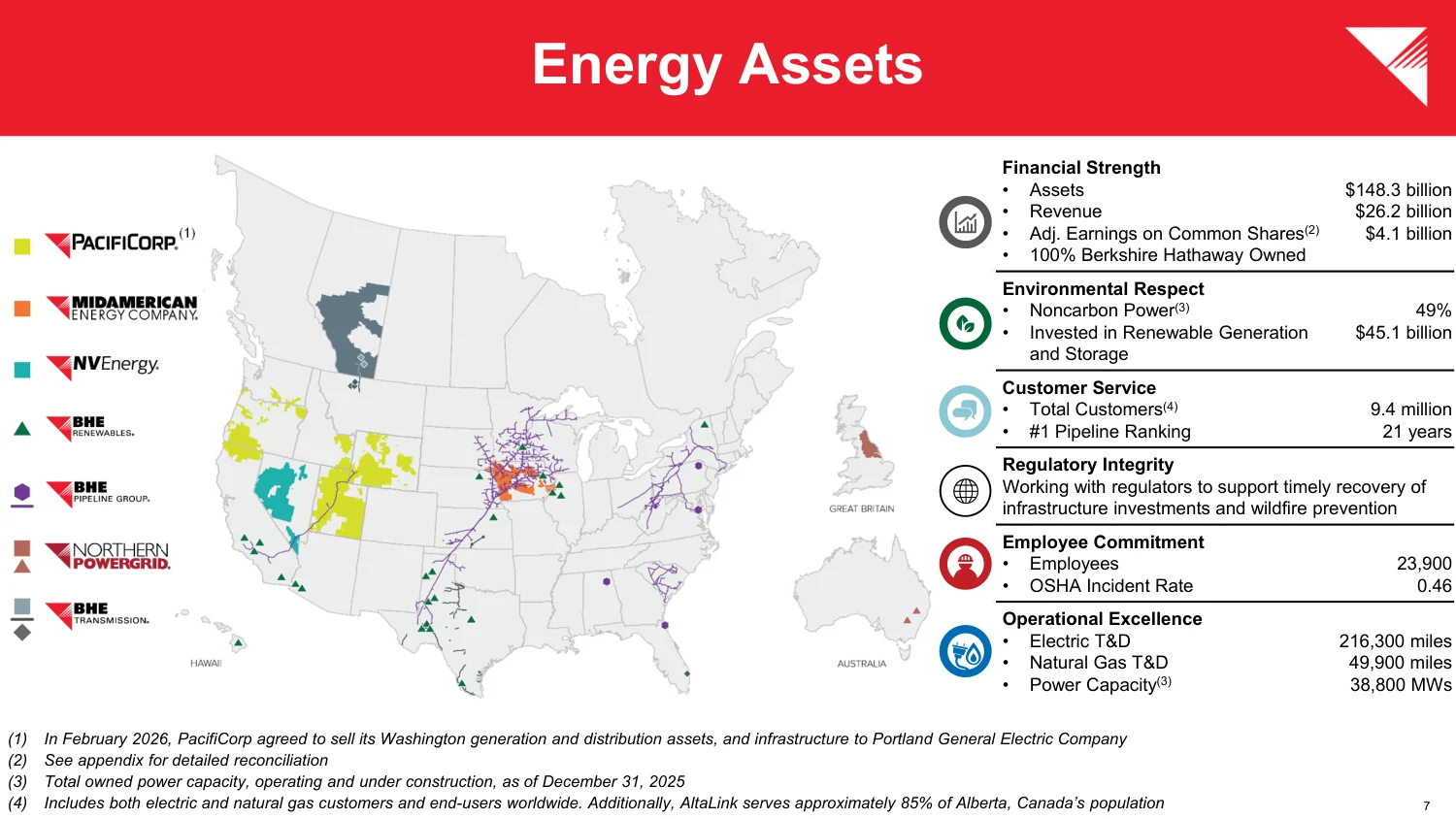
The earnings split matters more than the asset split, because the businesses earn at very different rates on what they own. The pipeline group is the clearest case: it holds about a sixth of BHE’s assets and produces more than a quarter of its earnings.
| $ millions | 2023 | 2024 | 2025 |
|---|---|---|---|
| Adjusted earnings on common shares | 3,746 | 4,350 | 4,054 |
| PacifiCorp wildfire losses, after tax | (1,265) | (261) | (75) |
| HomeServices settlement, after tax | — | (140) | — |
| Gain on BYD, after tax | 505 | 351 | 87 |
| Earnings on common shares | 2,986 | 4,300 | 4,066 |
The physical scale, and how the fuel mix changed
BHE owns 38,815 MW of generating capacity, 216,300 miles of electric transmission and distribution, and 49,900 miles of natural gas pipeline. It serves 9.4 million customers, of whom 4 million are Northern Powergrid end-users in northern England.
The fuel mix is where the story has moved. Coal was the largest single source for most of this record and is now being retired on a published schedule; wind went from almost nothing to the largest source of owned capacity. 49% of owned capacity is now noncarbon.
The load that artificial intelligence is adding
This is the part of the utility case that did not exist five years ago, and BHE now quantifies it precisely. Its utilities have contracted approximately 11,000 MW of data centre load, in service or in varying stages of construction. In 2025 the data centre peak load actually drawn was 2,200 MW, around 8% of total system peak.
The gap between those two numbers is the whole question. BHE expects contracted load in use to reach 4,500 to 5,700 MW by 2030 on the ramp schedules its customers have already requested, a compound rate of 15% to 21%. Historically data centres have taken 4 to 8 years to use the majority of what they contract.
The counterparty quality is the detail worth noticing: 91% of 2025 actual customer demand came from customers rated Aaa to Aa3. These are the hyperscalers themselves, not intermediaries, which is why BHE is willing to build for them.
At NV Energy alone, where the concentration is highest, data centre peak demand was approximately 400 MW in 2025 and the integrated resource plan forecasts 3,600 MW by 2030, nine times as much. NV Energy requires advances for distribution and transmission investment, and contracts with minimum bills and termination payments, specifically so that existing customers do not carry the cost if the load does not materialise.
The liability that changed the price
PacifiCorp lost $468 million in 2023, against $920 million of profit the year before. It is the sharpest discontinuity in twenty-seven years of this record, and it is the reason BHE’s return on equity is 7.5% and not its long-run 10.8%.
The cause is the 2020 Labor Day wildfires in Oregon and the 2022 fires that followed. PacifiCorp has settled over $2.2 billion of claims with approximately 4,600 plaintiffs. It has spent over $3.4 billion on wildfire prevention since 2019 and plans $2.8 billion more through 2028. Legislation limiting liability for noneconomic damages passed in Utah in 2024 and in Wyoming and Idaho in 2025, and a wildfire fund was legislated in Utah in 2024.
For the valuation, the thing that matters is that the loss is recognised and the owner has priced it. The 2024 repurchase, struck at an equity value of $62.9 B, is Berkshire marking its own subsidiary down by 29% and buying $2.9 B of it anyway.
Download the series (.xlsx) Berkshire Hathaway Energy, consolidated, with sources and the date it was struck written into the file. This page’s series only; there is no combined download.